In this mock draft, I will be focusing on the St. Louis Blues, and how they could transform their prospect pool in the 2026 NHL draft. The St. Louis Blues have three 1st round picks, Three 3rd round picks, Two 4th round picks, Two 5th round picks in the 2026 Draft, a total of 12 picks.
Related: New York Rangers

11- Tynan Lawrence (C) Boston University (NCAA)
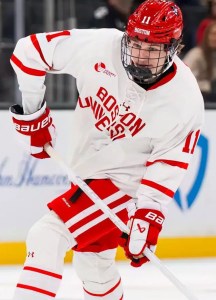
Tynan Lawrence is an ideal fit for the St. Louis Blues because he provides high-end insurance and long-term depth down the middle, perfectly complementing their current young core. Projected to be selected around the Blues’ 11th overall pick in the 2026 NHL Entry Draft, the Boston University center fits the exact strategic and stylistic identity that General Manager Doug Armstrong covets. The Blues are actively constructing a formidable, young center spine. Inserting Lawrence into the pipeline creates a multi-layered, highly sustainable top-nine group: Robert Thomas is firmly established as the elite, top-line playmaker, Rising star Dalibor Dvorsky represents the hard-nosed, offensive driving force. Selecting Lawrence gives the Blues a projected second-line center with top-six upside. Rather than forcing a single prospect to carry the load, Lawrence allows St. Louis to split premium offensive and defensive duties across three distinct lines. The Blues’ identity is traditionally built on heavy, detailed, 200-foot hockey—a style that directly aligns with Lawrence’s scouting profile. Evaluators praise Lawrence for his impeccable defensive instincts. He rarely cheats on plays, acts as a stellar backchecker, and effectively takes away passing lanes. Lawrence excels at using an effortless, downhill skating stride to exit his own zone and move through the neutral zone with pace. He avoids forcing plays and is a highly efficient zone-entry machine. With draft experts comparing his all-around utility to a mix of Macklin Celebrini’s play driving and a Patrice Bergeron lite style, he brings the exact “winning mindset” needed for postseason hockey. He is already a proven winner, having taken home Clark Cup playoff MVP honors in the USHL. Drafting Lawrence represents a high-value opportunity for the Blues. Earlier in the 2025–26 season, he was heavily regarded as a consensus top-five prospect. However, a mid-season transition from the USHL’s Muskegon Lumberjacks to the older, physically mature NCAA ranks with Boston University temporarily slowed his offensive production, causing his draft stock to slide. For a reloading team like St. Louis, getting a player with top-five pedigree and an incredibly safe NHL floor at pick No. 11 is a massive draft-day victory.
15- Malte Gustafsson (D) HV71 (Sweden U20)
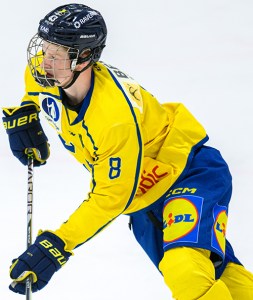
Malte Gustafsson is the right pick for the St. Louis Blues because he embodies traditional “Blues Hockey” while perfectly addressing their most glaring organizational weakness: top-four, left-shot defensive depth. Standing 6-foot-4 and 203 pounds, the HV71 defenseman possesses a rare blend of massive size and high-end mobility that aligns seamlessly with General Manager Doug Armstrong’s roster-building philosophy. The Blues’ future right side of the defense is already anchored by 2024 first-round pick Adam Jiříček. However, the pipeline desperately lacks an elite, shutdown left-shot counterpart. Pairing Jiříček’s right-handed transition game with Gustafsson’s left-handed, heavy defensive style creates a highly coveted, physically imposing top-four pairing for the next decade. St. Louis relies heavily on veterans like Colton Parayko for heavy-minute defensive duties. Gustafsson projects as a true “minute-munching” top-four defenseman who can eventually inherit those brutal, shutdown minutes. At just 17 years old, Gustafsson earned a prominent role for HV71, sometimes playing up to 20 minutes a game against grown men. : His stat line (3 points in 27 SHL games) doesn’t flash elite offensive numbers, but his ability to manage gaps, defend the rush, and win board battles against professionals proves his processing speed is already nearing an NHL level. Scouting reports highlight him as one of the best skaters in the 2026 draft class, possessing great agility and explosive lateral movement that allows him to close gaps instantly. He does not chase hits to out-of-position extremes. Instead, he uses his massive reach to take away passing lanes and delivers bone-crushing, clean checks along the wall to kill opposing transitions. Under pressure in his own zone, he is remarkably adept at baiting forecheckers before firing crisp, accurate outlet passes to his moving forwards. According to post-combine mock drafts, Gustafsson is heavily linked to the Blues at pick No. 15 (acquired from Detroit). By using their No. 11 pick on a high-upside forward (like Tynan Lawrence) and using No. 15 on Gustafsson, the Blues would execute a flawless draft strategy: securing an elite-IQ center spine while capturing a high-floor, physically dominant blueliner to fortify their defense.
29- Casey Mutryn (RW) USNTDP Juniors (USHL)
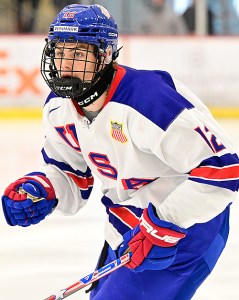
Casey Mutryn is the ideal draft target for the St. Louis Blues because he injects rare, top-tier power forward traits and elite leadership into a forward group that is transitioning into its next competitive window. The 6-foot-3, 203-pound right-winger from the U.S. National Team Development Program (USNTDP) perfectly fulfills General Manager Doug Armstrong’s vision of building a team that is big, fast, and relentlessly difficult to play against. St. Louis won its lone Stanley Cup in 2019 on the backs of heavy, punishing wingers who wore down opposing defenses. Scouting experts directly describe Mutryn as possessing that exact “will your way to winning the game” playoff style. He uses his frame to shield the puck along the boards, crashing the crease to score ugly, high-leverage goals. He led the USNTDP U18 team with 10 power-play goals this season. Unlike some heavy wingers whose footwork lags, Mutryn is a highly explosive skater. He plays with pure, unadulterated energy, using his speed to hunt down loose pucks and obliterate opponents on the forecheck. He served as the captain of Team USA at the 2026 IIHF World U18 Championship, proving he already commands the respect of elite locker rooms. Mutryn comes from a premier athletic background. His father, Scott Mutryn, was a standout quarterback for Boston College—the same legendary school Casey is committed to playing for next season. Analysts consider Mutryn to be one of the premier, safest defensive forwards in the entire 2026 draft class. : He is remarkably smart at recovering pucks, turning over the opposition, and immediately moving it into the slot. Placing Mutryn on a line with pure playmakers like Robert Thomas or Dalibor Dvorsky creates a balanced line where Mutryn does the dirty work along the walls, opening up premium ice for his skilled centers. Securing a player with a safe, virtually guaranteed NHL-ready floor at pick No. 29 is a major asset. Mutryn gives St. Louis a heavy-hitting, modern middle-six winger who ensures the next era of Blues hockey maintains its signature physical edge.

73- Egor Barabanov (F) Saginaw Spirit (OHL)
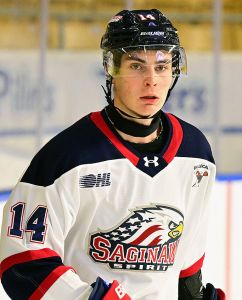
The St. Louis Blues should draft Egor Barabanov because he is the premier overage playmaker available in the 2026 NHL Entry Draft, offering an incredibly fast development runway for a reloading franchise.While the Blues are already utilizing high first-round picks to anchor their future core, selecting Barabanov in the 3rd round provides an explosive offensive catalyst who can transition to the professional ranks much quicker than a typical teenage draft pick. After being passed over in his first two draft cycles while finding his footing in the USHL, the 6-foot, 181-pound center exploded after moving to the OHL’s Saginaw Spirit. Barabanov finished fourth in OHL scoring during the 2025–26 season, racking up a massive 91 points (28 goals, 63 assists) in 68 games. In the annual OHL Coaches Poll, league coaches officially voted Barabanov as the No. 1 playmaker and the second-smartest player in the Western Conference. He possesses rare, elite vision and anticipation to break down defensive coverage. Barabanov is committed to the University of Massachusetts (UMass) for the 2026–27 season. Playing under head coach Greg Carvel—who is famous for instilling hard-nosed, pro-ready habits—will perfectly bridge his elite junior offense with the structural defense the Blues demand. His advanced statistical translation (NHLe) mimics that of established NHLers in their final pre-pro seasons. He is an asset who could legitimately sign an entry-level contract and push for a role in the AHL or NHL within just 12 to 24 months of being drafted. Scouts marvel at his elite weight-shifts and toe-drags at the top of the offensive zone. He routinely baits two defenders toward him before slipping a perfect, deceptive back-door pass to his wingers. Despite his pass-first mentality, he plays with a notable edge. He thrives in tight spaces, regularly operating out of the dirty “bumper” position on the power play and crashing the net to tuck away rebounds. Drafting a 90-plus point OHL center outside of the first round is rare value. By using their early picks on high-floor defensive pillars and traditional power forwards, St. Louis can use a Day 2 selection on Barabanov—essentially buying low on an elite offensive engine whose rapid upward trajectory is just beginning.
75- Mikey Berchild (LW) USNTDP Juniors (USHL)
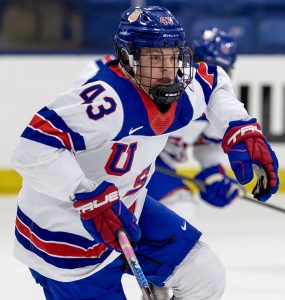
The St. Louis Blues should draft Mikey Berchild because he offers the mid-to-late round “home run” offensive potential they need to maximize the value of their deeper 2026 draft capital. While the Blues hold three premium first-round picks to anchor their future roster, adding Berchild in the middle rounds provides a high-skill, low-risk option to supercharge their future middle-six scoring depth. The 5-foot-10, 181-pound left-shot winger from the U.S. National Team Development Program (USNTDP) fits the exact profile of a highly creative playmaker whose draft stock dropped temporarily due to a slow, injury-impacted start to his draft season. Despite his sub-6-foot frame, Berchild is universally praised by scouts for having some of the most dynamic raw puck-handling skills in the draft class. He is remarkably skilled at manipulating defenders under the “stick triangle,” using rapid feints and edge work to escape pressure along the boards. The Blues’ development system loves agile wingers who can enter the offensive zone with control and immediately slow the game down to spot trailing trailers. Berchild excels at driving pace through the neutral zone and threading passes into high-danger areas. Berchild is committed to playing his college hockey for the University of Denver, a program renowned for turning agile, high-IQ, undersized forwards into dominant professional players. Letting Denver’s elite coaching staff refine his game means the Blues don’t need to rush his physical development. St. Louis can utilize the exact developmental patience they have shown with other collegiate prospects, allowing Berchild to naturally bulk up over the next two to three years while his offensive toolset matures. Peer scouts describe him as a player who is relentlessly “competitive” and “never gets hit” cleanly because his lateral shiftiness lets him absorb or avoid contact. Rather than perimeter-floating, Berchild deliberately attacks the slot and uses a highly lethal backhand and rapid release to score goals from dirty areas of the ice. With public draft boards projecting Berchild to drop into the 3rd to 5th round range on draft day, targeting him is a brilliant calculated gamble for Doug Armstrong. The Blues have already established a massive, physically imposing floor for their future with earlier picks like Malte Gustafsson and Casey Mutryn. Spending a mid-round asset on Berchild is the perfect counterweight—bringing a injection of pure, dynamic skill that could pay massive top-six dividends down the line.
76- Yegor Rybkin (G) Chaika Nizhny Novgorod (MHL)
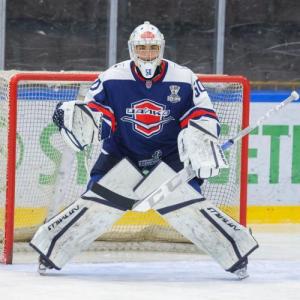
The St. Louis Blues should draft Yegor Rybkin because he provides the high-upside, long-term goaltending depth required to stabilize their future crease behind Joel Hofer. With the Blues holding significant mid-round draft capital in the 2026 NHL Entry Draft, selecting Rybkin represents a textbook calculated gamble on an elite physical package.Ranked as the No. 2 International Goaltender by NHL Central Scouting, the 6-foot-7, 207-pound Russian netminder possesses the modern, towering frame that General Manager Doug Armstrong and his front office heavily covet in their defensive anchors. Standing 6-foot-7, Rybkin covers the upper half of the net naturally just by maintaining a proper, upright butterfly stance. Unlike many teenage goalies of his size who struggle with tight-angle post integrations, Rybkin features a highly advanced Reverse-VH seal, cutting off short-side wrap-arounds with ease. Rybkin is a rare right-handed catching goalie. This subtly disrupts the natural shooting habits of left-handed NHL snipers who are visually trained to attack a traditional left-glove setup. The traditional risk with a 6-foot-7 goalie is slow, lumbering movement, but scouting evaluations praise Rybkin’s unexpected athleticism. He avoids getting stuck in his slides, contorting his body cleanly to make desperation saves.He relies on a highly structured, calm, blocking style. He relies on elite depth awareness to force shooters into firing wide rather than over-scrambling. Rybkin missed a large portion of his draft season due to an undisclosed injury. While his limited 11-game sample was stellar (5-2-0, .915 SV%), the injury creates a draft-day slide. Because of his limited exposure, Rybkin is projected to drop into the 3rd to 4th round. This allows the Blues to use their top-tier first-rounders on skaters, while utilizing a mid-round pick to draft a goalie with a legitimate NHL starter’s ceiling. Russian netminders routinely spend three to four years developing in the MHL and KHL before moving across the Atlantic. St. Louis can comfortably leave Rybkin in Russia to mature physically, aligning his eventual NHL arrival perfectly with the back half of Joel Hofer’s prime.
107- Will McLaughlin (D) Portland Winterhawks (WHL)

The St. Louis Blues should draft Will McLaughlin because he represents a high-IQ, modern, puck-moving defenseman who can drastically elevate the speed and transitional efficiency of their future blueline. Finishing his draft year ranked No. 57 among North American Skaters by NHL Central Scouting, the 6-foot-2, 168-pound left-shot defenseman from the WHL’s Portland Winterhawks is a surging prospect who lines up beautifully as a 4th-round draft target. He brings the precise blend of elite skating, space management, and championship pedigree that fits General Manager Doug Armstrong’s vision for a modern, active defense. In the modern NHL, defensemen must be able to escape heavy forechecks using their feet rather than just chipping the puck off the glass. McLaughlin is elite in this specific category. McLaughlin provides the blue-line creativity and vision that the Blues’ power play pipeline could greatly benefit from. Once established in the offensive zone, his agility allows him to laterally slide across the top of the zone with ease, consistently opening up clean passing and shooting lanes. Instead of firing predictable, easily blocked slap shots, McLaughlin utilizes rapid wrist-shot releases designed specifically to beat the first wave of defenders, aiming for deflections through heavy traffic. McLaughlin was a key structural cog for the U.S. Under-18 Men’s Select Team, helping them capture a Gold Medal at the prestigious Hlinka Gretzky Cup. His ability to seamlessly elevate his defensive details against the world’s best teenagers proves his hockey IQ translates to premier environments. McLaughlin underwent a massive physical transformation leading up to his draft season, shooting up from 5-foot-8 to his current 6-foot-2 frame. At 168 pounds, he is still incredibly lean. For a patient franchise like St. Louis, this represents a major advantage. His skating is already high-end; as he slowly packs on muscle and fills out his lanky frame over the next few years, his physical battles along the wall will become much more dominant. Whether he continues to marinate under Portland’s historically elite developmental staff in the WHL or transitions to his collegiate commitment at Colorado College, the Blues can safely let his physical strength catch up to his elite processing speed. Taking a flyer on McLaughlin in the middle rounds is the exact type of “shifty defenseman” gamble that can pay massive dividends. He offers the Blues a low-risk, high-upside transition weapon who perfectly rounds out a draft class already bolstered by heavier physical pillars like Malte Gustafsson.
123- Caelan Joudrey (RW) Wenatchee Wild (WHL)

The St. Louis Blues should draft Caelan Joudrey because he provides the specific combination of a massive physical frame and elite, high-motor defensive habits needed to secure their future bottom-six center depth.Projected as a 3rd to 5th-round pick in the 2026 NHL Entry Draft—where he surged up to No. 60 among North American Skaters by NHL Central Scouting—the 6-foot-4, 183-pound right-shot center from the WHL’s Wenatchee Wild fits perfectly into General Manager Doug Armstrong’s strategy of building a punishing, structured spine. While high-end draft picks supply the flashy offensive production, championship rosters require heavy, high-IQ checkers who can lock down elite opponents. Joudrey projects as a premier modern shutdown weapon. : Scouts consistently marvel at Joudrey’s defensive pace and spatial awareness. He constantly moves and scans his zone, using perfectly timed stick lifts to disrupt cycles and eliminate threats. When facing high-powered junior teams, Wenatchee routinely deploys Joudrey in a strict matchup role. His relentless motor and refusal to cheat on plays allow him to consistently win grueling wall battles and smother transition rushes. Joudrey’s offensive numbers are modest but rapidly growing, exploding from a 16-point rookie WHL campaign to 19 goals and 29 points in 2025–26. Joudrey is committed to playing NCAA hockey for Quinnipiac University. Quinnipiac is a national powerhouse famous for transforming raw, heavy-skating junior players into highly structured, pro-ready college stars. By drafting Joudrey, the Blues can comfortably allow him to refine his puck skills and offensive generation in the NCAA for three to four seasons before bringing him to the professional ranks. Championship teams are insulated by drafting specialized roles on day two of the draft. Having secured elite playmakers with their early picks, spending a mid-round asset on Joudrey gives St. Louis a right-handed, 6-foot-4 center with an elite work ethic and a safe NHL floor as a premium penalty killer and shutdown third- or fourth-line center.
139- Oscar Olsson (LW) Orebro HK (Sweden U20)
150- Joseph Erickson (C) Blake School (USHS-MN)
171- Zachary Jovanovski (G) Guelph Storm (OHL)
203- Bode Laylin (D) Tri-City Storm (USHL)
Draft Summary
11- Tynan Lawrence
15- Malte Gustafsson
29- Casey Mutryn
73- Egor Barabanov
75- Mikey Berchild
76- Yegor Rybkin
107- Will McLaughlin
123- Caelan Joudrey
139- Oscar Olsson
150- Joseph Erickson
171- Zachary Jovanovski
203- Bode Laylin