
Landon DuPont is the consensus No. 1 pick for the 2027 NHL Entry Draft because he is widely regarded as a generational, franchise-altering talent on the blue line. Scouts and analysts frequently compare his play style to a hybrid of NHL superstars Cale Makar and Quinn Hughes. Here are the core factors driving his status as the crown jewel of the 2027 draft class.

Why he is the Crown Jewel of the 2027 Class
Landon DuPont was granted exceptional player status to enter the Canadian Hockey League (CHL) early, becoming only the second defenseman in Western Hockey League (WHL) history to earn the distinction. This put him in elite company alongside other historic exceptional-status prodigies like Connor McDavid, Connor Bedard, and John Tavares. His game is built on a flawless, elite skating foundation [index:1.1.9]. DuPont uses advanced edge work, quick direction changes, and deception to effortlessly shake forecheckers and escape pressure [index:1.1.9]. Like Makar, he possesses explosive north-south speed that allows him to seamlessly lead end-to-end rushes and transition the puck from defense to offense in the blink of an eye. DuPont operates like a true modern-day NHL power-play quarterback [index:1.2.6]. He has elite vision and puck-distribution skills, letting him look off defenders and manipulate lanes to feed high-danger areas. This translated into historic junior production, where he racked up 73 points in 63 games for the Everett Silvertips as a young 16-year-old. He has consistently shown that his game easily translates against older, elite international competition. Captaining Team Canada at the recent Hlinka Gretzky Cup, DuPont completely dominated from the blue line—capping off the tournament with a staggering four-point performance in the gold-medal game against the United States. To fast-track his development ahead of the 2027 draft, DuPont committed to the University of Michigan. Stepping straight into a premier NCAA program as a 17-year-old freshman allows him to test his hockey IQ and physical maturity against older, stronger collegiate athletes, all but solidifying his draft portfolio.
Comparing his trajectory to other historic exceptional-status players
When looking at how exceptional status players performed in their first major junior seasons, DuPont’s production sits remarkably high—especially for a defenseman. He scored 60 points in 64 regular-season games as a 15-year-old.
The Top Tier (Connor Bedard & John Tavares): Bedard (28 points in 15 games in a shortened season) and Tavares (77 points in 65 games) hold the gold standard for immediate offensive dominance. DuPont’s rookie scoring rate was actually statistically closer to elite exceptional-status forwards like Shane Wright (66 points) and Connor McDavid (66 points) than it was to typical defensemen. Aaron Ekblad, the only other Defenseman to be granted exceptional status, scored 29 points in 63 games during his exceptional rookie year in the OHL. DuPont nearly doubled Ekblad’s scoring pace, racking up 60 points and becoming the first 16-or-under defenseman to hit 50 points since Hall-of-Famer Scott Niedermayer in 1990. DuPont won the 2025 CHL Rookie of the Year award. He is one of only three exceptional-status players in hockey history to capture this national trophy, alongside John Tavares and Shane Wright. Even Connor Bedard and Connor McDavid missed out on this specific national award due to regional voting and shortened seasons. DuPont helped lead the Everett Silvertips to their first-ever WHL Championship. Many exceptional status players (like John Tavares or Shane Wright) spent their early draft-matured years on rebuilding junior teams. DuPont, much like Connor Bedard on the international stage, has been a driving force for winning teams early on. Historically, every single exceptional status player (including McDavid, Bedard, Tavares, and Ekblad) spent all three of their pre-draft developmental years entirely in the Canadian Hockey League (CHL). DuPont broke the mold. After conquering the WHL in just two seasons, he opted to leave major junior hockey to spend his draft-eligible season with the University of Michigan in the NCAA. This moves his trajectory away from traditional CHL phenoms and aligns him with the developmental paths of modern NHL blueline anchors like Quinn Hughes and Zach Werenski—testing himself against grown men in college hockey a year ahead of schedule.

How DuPont performed at the 2026 Hlinka Gretzky Cup
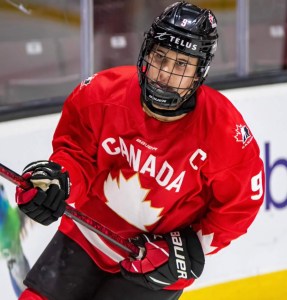
At the 2026 Hlinka Gretzky Cup in Edmonton, Landon DuPont fully cemented his status as a generational talent, captaining Team Canada to a flawless 5-0 record and a gold medal finish.
Tournament stats:
GP: 5
G: 2
A: 6
Total Pts: 8
Pts/GM: 1.60
Key Performance Takeaways
DuPont’s 8 points led all defensemen in the tournament in scoring. He saved his best performance for last. In the final match against the United States, DuPont recorded 4 assists to lead Canada to a dominant 8-1 victory. DuPont directed a lethal Canadian power play, repeatedly setting up teammates like Maddox Schultz and Brock England for premium scoring chances. After settling for a bronze medal at the tournament the previous year, DuPont returned with a mission to bring gold back to Canada—delivering the nation its 14th gold medal in the last 18 editions of the tournament
How his game fits with the University of Michigan
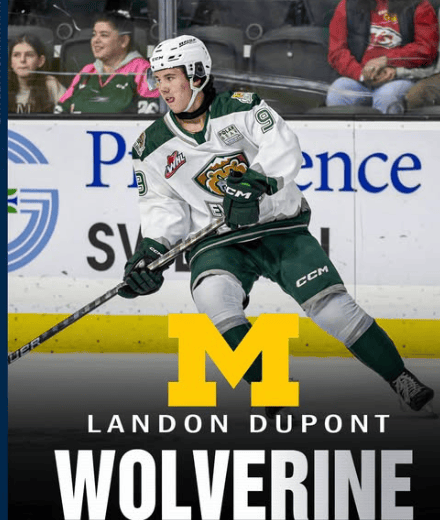
Landon DuPont’s fit at the University of Michigan is a match made in hockey heaven. The Wolverines have built a reputation as the premier NCAA factory for elite, high-scoring modern defensemen—most notably producing Norris Trophy winner Quinn Hughes and NHL All-Star Zach Werenski.
How His Style Fits Michigan’s System
1 The Ultimate Power-Play Quarterback: Michigan routinely plays a fast-paced, highly skilled offensive game that thrives on defensemen who can act as a fourth forward. DuPont was recruited specifically to command the Wolverines’ top power-play unit. His elite vision and rapid puck-distribution skills will allow him to seamlessly feed Michigan’s high-end forward talent.
2 Surrounded by Insane Draft Pedigree: Unlike past junior stars who had to carry entire franchises on their backs, DuPont joins a stacked roster. Opponents cannot simple double-team or isolate him because the Michigan Wolverines boast an elite core that includes five NHL first-round draft picks like Cameron Reid (Nashville Predators), Michael Hage (Montreal Canadiens), J.P. Hurlbert (Detroit Red Wings), Jack Nesbitt (Philadelphia Flyers), and Will Horcoff (Pittsburgh Penguins).
3 The “Gavin McKenna” Blueprint: College hockey is older, faster, and more physical than major junior leagues. Following the path of fellow elite prospect Gavin McKenna (who fast-tracked to Penn State), DuPont’s transition to the NCAA forces him to defend against 22- to 24-year-old men. This will immediately test and refine his underrated defensive transition game and tight gap control against top-tier competition before he enters the NHL.
Full Scouting Report
Positon: Right-shot Defenseman
Height/Weight: 5’11”-6’0″/190-192 lbs
Current team: University of Michigan (NCAA)
NHL Comparable: Quinn Hughes/Cale Makar
NHL Projection: Tier 1, Top-pairing NHL defenseman who can transform a franchise

Elite Strengths & Key Tools
1. Elite Five-Zone Skating & Mobility: DuPont possesses flawless, effortless skating mechanics. He has a rapid first step that blows by opponents and elite edge work that allows him to change direction instantly to break heavy forechecks. His ability to smoothly transition from skating backward to lunging forward into an offensive attack is already at a pro-ready level.
2. Advanced Power-Play Quarterbacking & Hockey IQ: He has perfect spatial awareness and a genius-level hockey IQ. DuPont can look defenders off, manipulate passing lanes, and reliably deliver cross-ice seam passes onto teammates’ sticks. He plays like a “fourth forward” on the rush, knowing exactly when to pinch deep into the offensive zone to create odd-man advantages.
3. Aggressive Gap Control: Defensively, he relies on his speed to choke out opposing transitions. He plays a very tight “gap,” meaning he stays extremely close to oncoming attackers, using a quick, active stick to strip the puck cleanly before they can reach the blue line
4. Sneaky Physicality and Net Front Strength: DuPont is incredibly sturdy and strong for his size. He uses low leverage and a thick build to push larger forwards away from the front of his net. He does not shy away from physical contact along the boards and is happy to throw his weight around
Areas for Improvement & Weaknesses
1. Rushed Decision Making Under High Pressure: Because DuPont plays a hyper-fast, aggressive style, he can occasionally struggle with overhandling the puck or making a risky play when he gets rushed by a heavy, physical forecheck.
Learning when to slow the game down and make the safe, simple play is his primary developmental goal.
2. Finishing/Shot Power: While his wrist shot is accurate and features a lightning-quick release to generate rebounds, he lacks a booming, heavy point shot or one-timer [index:1.1.3]. Adding raw mechanical power to his slap shot will help make him a dual-threat scorer from the blue line




One thought on “WHY LANDON DuPONT IS THE CONSENSUS NO.1 PICK IN 2027 NHL DRAFT”