In this mock draft, I will be focusing on the Vancouver Canucks, and how they could transform their prospect pool in the 2026 NHL draft. Vancouver has a total of 10 picks in the 2026 draft, including 2 1st, 2 2nd, and 3 5th round picks.
Related: Calgary Flames Mock

3- Caleb Malholtra (C)- Brantford Bulldogs (OHL)

The Vancouver Canucks should draft Caleb Malhotra because he is the near-consensus top natural center available in the 2026 NHL Entry Draft, combining an elite two-way game with massive organizational and hometown familiarity. Holding the third overall pick, Vancouver has a unique opportunity to draft a foundational piece to anchor their future forward core. The Canucks’ pipeline lacks a blue-chip center capable of transitioning into a top-six NHL role. Malhotra represents the “spine of a team”—a reliable middle-of-the-ice presence. Initially projected as a mid-first-rounder, Malhotra exploded for 84 points in 67 regular-season games for the OHL’s Brantford Bulldogs. He followed it up with a spectacular playoff run, racking up 26 points in 15 games. His 13 postseason goals are the fourth-most by a rookie in OHL history, drawing draft-year comparisons to Jonathan Toews. Unlike pure offensive wingers, Malhotra plays an exceptionally mature, low-risk defensive game with deep defensive-zone reliability. Scouts project him as an all-situations player who can shutdown top opposing lines or serve as a high-end playmaker. He finished his OHL season as a plus-43. He is the son of former Canucks center and current AHL Abbotsford head coach Manny Malhotra. Caleb grew up around the Canucks’ locker room during the Sedin and Luongo era, which means he is already intimately accustomed to the pro lifestyle and the Vancouver media market. Malhotra possesses a relentless motor, physical assertiveness, and top-tier hockey IQ. He fits the exact high-character, tactically versatile identity the Canucks management is trying to establish.
24- Marcus Nordmark (LW/RW)- Djurgarden (SWE-J20)

The Vancouver Canucks should draft Marcus Nordmark because he is one of the most dynamically gifted offensive playmakers in the 2026 NHL Entry Draft, offering the rare combination of high-end Swedish puck skill and a pro-ready 6-foot-2 frame. While he is a more polarizing prospect than a safe two-way center, Nordmark possesses an elite ceiling as a top-six winger who can dramatically elevate a team’s transition game and power play. Rated by many scouts as the second-best pure playmaker in this draft class, Nordmark possesses elite hands and vision. He excels at manipulating defenders, slowing the game down, and finding passing seams from the half-wall. Playing for Djurgårdens IF, he posted a staggering 1.52 points-per-game pace in Sweden’s top junior league, ranking third among all draft-eligible players over the last decade. He followed that up by exploding for 23 points in just 11 playoff games. Standing 6-foot-2 and weighing 187 pounds, Nordmark has the physical tools that modern NHL front offices crave. He utilizes an explosive mid-stride burst to drive into defenders off the rush and power from the boards to the middle of the ice. Nordmark was the driving force behind Sweden’s success on the international stage, leading the 2025 Hlinka Gretzky Cup in scoring with seven goals and 12 points in five games. His patience with the puck and deceptive snap-shot make him an ideal future fit for a high-end NHL power play, potentially serving as an elite commercial conduit alongside 3rd overall pick Caleb Malholtra.
33- Alexander Command (C)- Djurgarden (SWE-J20)

The Vancouver Canucks should draft Alexander Command because he is one of the most meteoric risers in the 2026 NHL Entry Draft, projectable as a prototypical, hard-nosed NHL third-line center who offers a rare blend of defensive reliability and heavy physical play. Slated to pick in the 20s overall after their regular season, the Canucks have a distinct opportunity to grab a trustworthy, complete Swedish center who plays a style tailored perfectly for postseason hockey. Command began his draft season with an NHL Central Scouting preliminary grade of “W” (projected as a 6th or 7th round target). He completely changed that narrative, skyrocketing into a consensus first-round talent who ranks as high as 11th among European skaters and 16th overall on major boards. Playing for Örebro HK’s U20 team in Sweden, he finished 9th overall in league scoring with 44 points (17 goals, 27 assists) in just 30 games. He replicated that point-per-game pace on the world stage, scoring 21 points in 21 international contests, culminating in a gold-medal run at the U18 World Championships. NHL scouts rave about his execution in small areas and his elite 61% faceoff winning percentage. He plays a heavy, inside-ice game, averaging 1.39 hits per game, using his 6-foot-1, 187-pound frame to win puck battles along the wall and maintain possession down low. Evaluators state that Command is a flat-out “hockey player” with virtually no gaping holes in his game. He can be trusted on the penalty kill, out there holding a lead late in games, or driving a secondary offensive cycle line. Analysts compare him closely to modern, heavy Swedish centers like Milton Gastrin. Command focuses on giving his wingers maximum structural support, doing the dirty work defensively, and opening up clear ice lanes for creative playmakers.
41- Mathis Preston (RW)- Vancouver Giants (WHL)

Mathis Preston is a phenomenal fit for the Vancouver Canucks because he addresses the organization’s most glaring long-term need: a high-ceiling, dynamic game-breaker with an elite goal-scoring tool kit. Slated as a projected mid-to-late first-round selection in the 2026 NHL Entry Draft, Preston provides an explosive offensive punch that perfectly matches the timeline and up-tempo style of Vancouver’s current core. Furthermore, he offers a level of localized familiarity that the front office loves, having been traded to the local Vancouver Giants (WHL) midway through his draft season. Preston is a big-game player who shines brightest on international stages when surrounded by elite talent; he led Team Canada in scoring at the Hlinka Gretzky Cup, which included a clutch third-period hat trick against Switzerland. At the U18 World Championships, he finished tied for third in Canadian team scoring, putting up 5 points in the tournament’s early stages to drag his draft stock back into the first-round conversation. Outside of Jonathan Lekkerimäki (who missed crucial development time due to shoulder surgery), the Canucks’ prospect system is lean on pure, terrifying goal-scoring threats. Preston boasts one of the most dangerous, deceptive shot releases in the entire draft class. He can beat goaltenders cleanly from distance, change his blade angle mid-stride, and serves as an instant power-play weapon. Preston plays the exact style of fast, creative hockey preferred by the modern NHL. He possesses elite, multi-layered skating and explosive acceleration that allows him to back off defenders and push the pace through the neutral zone. Scouts note that he is the type of player who can completely take over a shift out of nowhere to turn a game around. Despite playing on a lower-scoring squad, data analysts tracked that Preston contributed to over 40% of his team’s goals while on the ice—the highest share of any CHL player in his draft class. Preston would be an excellent 2nd round draft pick, because teams have shown they value size over skill and that will cause a player like Preston
to drop out of the first round despite his elite level skillset.
78- Viggo Tamm- (G)- Leksands IF (SWE-J20)
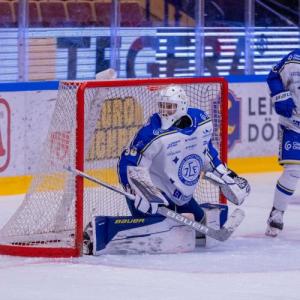
Viggo Tamm is a highly logical target for the Vancouver Canucks because he perfectly fills the organization’s need for a long-term developmental goaltending prospect to stock their pipeline behind Thatcher Demko. As a projected mid-to-late round pick in the 2026 NHL Entry Draft, the towering Swedish netminder gives Vancouver a low-risk, high-upside project who can be molded by the Canucks’ elite goaltending development department. Standing 6-foot-5 and 165 pounds, Tamm possesses the ideal frame for a modern NHL goaltender. According to Elite Prospects’ scouting reports, he is an exceptionally fluid mover for his size, utilizing high-end explosiveness to slide post-to-post and telescope out to challenge shooters. He naturally cuts off shooting angles simply by standing in his crease. The Canucks’ goaltending department—highly regarded for maximizing the talents of Thatcher Demko, Artūrs Šilovs, and Kevin Lankinen—covets large, athletic goalies with raw toolsets. Tamm is notoriously praised for tracking the puck through traffic but still has mechanical flaws, such as leaving occasional holes in his stance. He represents exactly the type of “clay” Vancouver’s coaching staff excels at reshaping into structurally sound NHL depth. Playing his first full season at the U20 Nationell level for Leksands IF, Tamm earned a respectable 14-9-0 record with a .900 save percentage and a 2.75 GAA over 30 games. He also handled high-pressure environments well on the international stage, stopping 89 shots to help backstop Sweden to a bronze medal at the World Junior A Challenge. Goaltenders historically take longer to mature. Drafting Tamm in the later rounds allows the Canucks to leave him in Europe for three to four years to physically fill out his frame and gain Swedish Hockey League (SHL) experience before coming to North America.
97- Tomas Kralovic (D)- HC Bratislava (Slovakia)

Tomáš Královič is an exceptionally strong target for the Vancouver Canucks because he perfectly fits the organization’s strategic vision of injecting size, right-shot mobility, and European pro-leveled poise into their defensive pipeline. As a 20-year-old overage prospect eligible for the 2026 NHL Entry Draft, the Slovak blueliner represents a highly projectable, late-blooming asset that matches the physical identity Vancouver’s front office covets. Right-handed defensemen who possess legitimate NHL size are the rarest and most expensive commodities in hockey. Standing 6-foot-3 and 203 pounds, Královič gives the Canucks an imposing physical presence on the right side. He leverages his reach to shut down passing lanes, clears the net front with authority, and protects the puck exceptionally well under pressure along the boards. Unlike prospects playing strictly against teenagers in major junior leagues, Královič spent his draft year playing heavy, structured minutes against grown men for HC Slovan Bratislava in the Slovak Extraliga. This European pro experience means he has already adapted to faster forechecks and heavier cycles, shortening his transition runway to the AHL’s Abbotsford Canucks. According to elite scouting evaluations, such as McKeen’s Hockey “Second Chances” profile, Královič is one of the draft’s most notable risers. Scouts praise his breakout progression, noting that he transformed from a simple, bottom-pairing shutdown option into a highly mobile asset who supports transitions and efficiently moves play forward without overcomplicating his game. Following Vancouver’s blockbuster trade sending Quinn Hughes to the Minnesota Wild for a package of young assets, rebuilding the blueline systematically is a top priority. Because Královič is an overage prospect, his physical baseline is already mature. He provides a team like Vancouver—which needs ready-to-inject depth—a player who can be signed immediately and doesn’t require a half-decade of physical framing.
129-Braidy Wassilyn (C)- London Knights (OHL)

Braidy Wassilyn fits the Vancouver Canucks because he perfectly fills the team’s ongoing need for skilled, highly competitive, and tenacious forward depth. Expected to be a mid-to-late round target in the 2026 NHL Entry Draft, Wassilyn is a left-shot forward who pairs premium puck handle capability with a heavy, pesky playing style. He fits the high-tempo, hard-forechecking model favored by Canucks management. Scouts rate Wassilyn as having some of the best pure puck control in his age group. He is uniquely effective at navigating tight, suffocating defensive structures along the wall and creating offense out of high-pressure, low-space areas. Following his high-profile early-season trade from Niagara, Wassilyn spent his draft year refining his game under the legendary developmental staff of the London Knights (OHL). He posted a strong 41 points in 56 games after the trade, learning to play within a winning, structured environment. Despite standing at 5-foot-11 and 194 pounds, he plays with a stocky, heavy frame and an aggressive edge. He loves to drive directly to the net, finish checks, and play an irritating, high-energy style that wears down opposing defensemen. Evaluators from Daily Faceoff note that Wassilyn elevates his performance when the pressure is highest, making him a reliable option to generate scoring chances late in tight hockey games. Like previous top targets, Wassilyn is committed to Boston University (NCAA). This allows the Canucks to secure his rights and let him develop his defensive game over several college seasons without burning an entry-level contract slide year.
161- William Lundqvist (D) 6’4/214- Leksands IF (SWE-J20)
William Lundqvist is a highly practical and strategic target for the Vancouver Canucks because he addresses the organization’s persistent need for size, structural defensive discipline, and heavy physical depth on the backline. Standing 6-foot-4 and 214 pounds, Lundqvist is a physical force. He naturally projects as a bruising, shutdown, stay-at-home defenseman who can clear the net-front with authority and effectively pin opposing forwards along the boards. Playing for Leksands IF J20 in Sweden’s top junior league, Lundqvist logged heavy structural minutes. Scouts value his long reach, steady positional gap control, and low-risk breakout decisions, making him an ideal modern penalty-killing anchor. With Vancouver’s systems depending heavily on mobile, active puck-moving defensemen, Lundqvist projects as the perfect defensive-minded counterweight. His low-risk, safety-first approach allows him to act as an anchor, giving his defensive partner maximum freedom to activate offensively. As a late-2007 birth year, Lundqvist is one of the younger defensive prospects in this class. Selecting him allows the Canucks to leave him in Sweden for another two to three years to build lower-body strength and transition into the professional Swedish Hockey League (SHL) before coming to North America.
176- Benjamin Wilmott (C) 6’1/190- Montcon Wildcats (OHL)
184- Theodore Lechner (D)- 6’3/170- Academy of Holy Angels (USHS-MN)
Draft Summary
3- Caleb Malholtra
24-Marcus Nordmark
33- Alexander Command
41-Mathis Preston
78-Viggo Tamm
97-Tomas Kralovic
129-Braidy Wassilyn
161-William Lundqvist
176-Benjamin Wilmott
184-Theodore Lechner


One thought on “2026 NHL DRAFT: VANCOUVER CANUCKS MOCK”